
Housekeeping
And a Reading Suggestion (If You Can Find It)


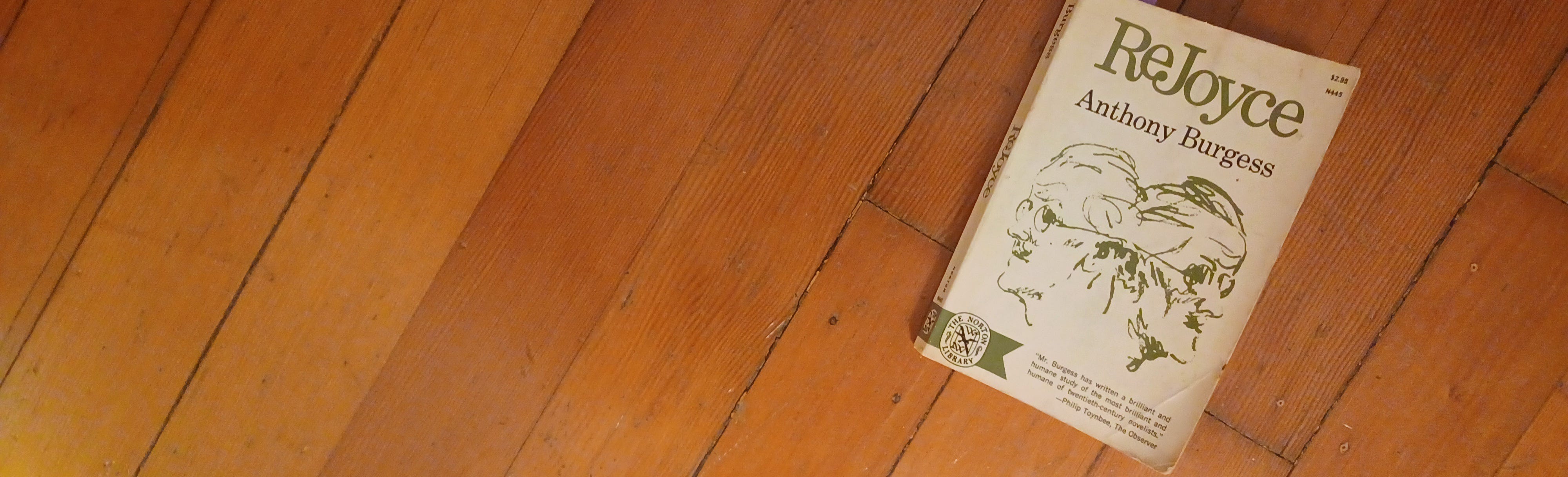
As of Late
I’ve sought out fiction written by writers who were first linguists. These include Tolkien, Joyce and Burgess. Imagine my happiness when Joe of Belmont Books dug out a 1965 copy of Re Joyce, a chatty introduction to Joyce’s Ulysses and Finnegan’s Wake — with plenty of Dubliners and A Portrait of the Artist as a Young Man thrown into the discussion — written by Anthony Burgess.
Burgess comes across as the funniest, brightest teacher one could ever meet. Due to his admiration of Joyce, to read this book is like poring through a stack of love letters. We always glow when we can articulate our admiration for something or someone. We love people who love, so Re Joyce bursts like a party, and not just about Joyce, but about reading and writing as well.
Just a few insights Burgess offers:
A great writer modifies everything. (page 18)
I have never felt inclined to condemn people who look for dirt in literature: looking for dirt, they may find something else. I do not think that those of my fellow-soldiers who read paperback pornography for masturbatory thrills saw that sort of stuff as of the same order as The Decameron or Joyce’s dirty book. In literature (recognizable as such through bulk, hard words, long stretches of boredom) they wanted confirmation that sexual desire, sexual exercise, and sexual obscenity were valid aspects of life. (page 18)
I am convinced that many novel-readers go to a book not merely for the story but for the companionship of the teller of the story — they want a friend with a somewhat greater knowledge of the world than themselves, one who knows the clubs, a good cigar, Tangiers and Singapore, who has perhaps dallied with strange women and read odd books, but who remains friendly, smiling, tolerant but indignant when the reader would be indignant, always approachable and always without side… read Ian Fleming and you will meet the globe-trotting clubman who is one of the lads… No face shines through the novels of James Joyce, and this is disturbing. (page 24)
Whether the primacy of the ear and the tongue in Joyce is, building on a natural endowment, fate’s way of compensating him for weak sight and, later near-blindness — this is not profitable to debate. Blind Homer is a strongly visual poet, blind Milton is not. The weak-sighted cherish what little they can see; the near-sighted turn themselves into microscopes. I am myself a novelist classified as “partially sighted,” but the visual world exists for me, especially in the close print of cigarette-ends in a dirty ashtray, segs on potato-peeling fingers, the grain of wood, the bubbles in tonic water, a painter’s brushwork.1 (page 29)
Everything in Joyce’s writing is an enhanced record of the author’s own experience, but perhaps The Dead is the most personal item in the long chronicle of Dublin which was his life’s work. (page 43)
Joyce’s books are about human society, and most social speech is ‘phatic”, to use Malinowski’s useful term.2 It concerns itself less with conveying information, intention or need than with establishing and maintaining contact — mere comfort noise in the dark. Irish town speech is the most phatic of the entire English-speaking world: it is all color, rhythm and gesture. (page 46)
Your list of best-sellers always includes the pornographic (the arousers of desire) and the didactic (the books which tell you what to do). Combine the didactic and the pornographic, as in some Hindu sex-manual, and you have your best best-seller. (page 63)34
If you can get your hands on a copy, Re Joyce is a treat. And an education
Now Some Housekeeping
No word yet from our last two winners:
Sam: “You can rest now Annie.”
And:
Bree LeMaire: “It hurts now, to see her so fucking happy.”
The packages await your mailing address. And your instructions for inscribing the book. Please let me know in the Comments, here, and I’ll delete the information as soon as I see it. Or, send your mailing address and inscription via The Cult. Unclaimed prizes will eventually go to charity.


Burgess also cites Huxley as a writer with limited, failing eyesight. It’s never occurred to me to write a near-blind character, but it excites me to do so by depicting only such tiny, close-up details of the world. To create scenes in which only details within an inch of the narrator’s nose are depicted. That would be a fun challenge.
This distinction was new to me, too. Basically, it means small talk.
In 1996 Fight Club was the cover story of the Los Angeles Times Book Review. The reviewer called the novel “didactic.” To which my agent quipped, “The three most useless things in the world are the Pope’s dick, a nun’s cunt, and a good review in the Los Angeles Times.”
Isn’t this also the recipe for successful YouTube?
Your agent is savage! Love it!
Chuck, I just managed to find a US address in Missoula where the book can be send. I'm waiting confirmation from my friend. I'll put it here in the comments surely in the weekend. Good luck to you all with the harsh weather, in Sicily it's been gnarly. Take care.